Smart Toilet Sourcing Starts with the Exact Model
Smart toilet sourcing for wholesale or project orders requires an exact configuration, installation drawing and destination-market review. Do not assume every model includes automatic lid operation, seat heating or a tankless flushing system.
Compare the supplied components and documents when selecting a Sanitary Ware Manufacturer . A supplier label or a low price alone does not establish suitability or profitability.
This guide describes practical order checks using 9CREAT as the manufacturing context. Its ceramic factory general manager has more than 15 years in the role; that experience is not the age of every factory or evidence of universal certification.

Phase 1: Confirm the Product and Producing Facility
Confirm which facility supplies and assembles the selected configuration rather than infer component performance from a production region.
Verify Facility and Component Responsibility
A smart toilet consists of two distinct parts: the ceramic bowl (the body) and the electronic bidet seat/flushing system (the brain).
-
Chaozhou is the location of 9CREAT’s ceramic factory, established in 2011. Location alone does not establish ceramic properties.
-
Wenzhou is the location of the hardware factory following its 2017 relocation from Nan’an, where it was established in 2014. This history does not establish electronic-board production.
Factories, traders and sourcing partners can have different arrangements. Ask who produces, assembles and inspects the ordered components; do not assume a business type guarantees suitability.
The 9CREAT Manufacturing Background
For an order involving multiple product categories, distinguish the confirmed factory scopes:
-
Chaozhou ceramic factory: Confirm the selected ceramic model, drawing and applicable inspection records.
-
Wenzhou hardware factory: Confirm the selected faucet, shower or other hardware configuration; electronic-component manufacture is not established by this article.
Order coordination: Confirm how components, installation interfaces and approvals are coordinated for the chosen model. Common branding is not a universal performance guarantee.
Phase 2: Check the Model and Destination Documents

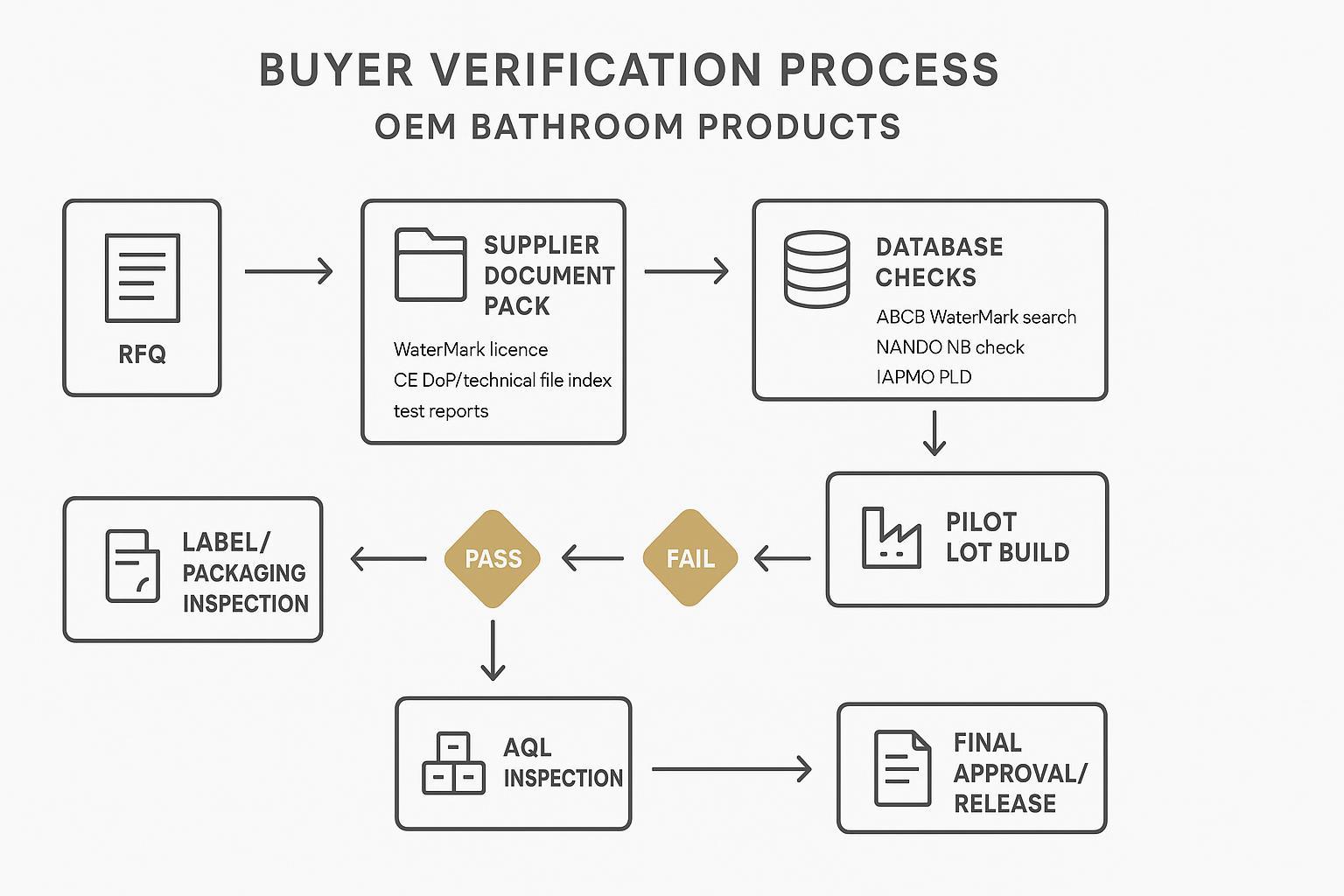
Determine the requirements for the destination and installation. Do not rely on claims that every market follows one universal approval path.
1. Applicable Certification and Documentation
Ask which documents and listings apply to the exact configuration and intended use.
North America: CUPC (for plumbing standards) and UL/ETL may be relevant depending on the product and jurisdiction. For the Tankless Smart Toilet Series, request the actual listing; this overview does not establish certification for the entire series.
Europe: CE requirements depend on the applicable product legislation; review RoHS applicability separately for the electrical configuration.
Australia: WaterMark scope and the current product listing should be checked where the scheme applies.
Official verification: You should always verify a supplier’s claims directly on the official IAPMO Database for CUPC
2. The “Hidden” Quality Tests
Ask for the inspection method, sample scope and results relevant to the selected model. A claim of complete water and ageing testing needs supporting records; it is not established for every product here.
Include the flush specification, electrical configuration and installation conditions in the review.
3. OEM/ODM Capability for Brand Building
As a wholesaler, you aren’t just buying products; you are building a brand. You need a partner, not just a supplier.
Confirm the proposed OEM options and applicable order quantity for the selected model:
Custom Logo: Confirm the proposed logo location and available method.
Custom Packaging: Confirm artwork, packaging specification and any agreed testing.
Function Customization: Provide the proposed change for feasibility and document review; no function is automatically available on every model.
Phase 3: The Step-by-Step Import Process

Step 1: Inquiry and Specification
Provide the destination, exact model, electrical requirements and quantity. Confirm these against the model documentation.
Step 2: Sampling (Crucial!)
Choose a sample matching the proposed order configuration, such as Model JCTECH-0416 , and define the inspection and acceptance criteria.
Step 3: Production & Inspection
Smart toilet production, including T3, uses 30–45 days. Agree on the inspection arrangements and approval steps before shipment; a container size alone does not define every order schedule.
Step 4: Shipping and Logistics
Confirm the agreed trade terms and included services.
-
FOB (Free On Board): Confirm the quoted port and responsibilities under the agreed FOB terms; Shantou is the main ceramic export port.
-
DDP (Delivered Duty Paid): Door-to-door services may be coordinated with freight partners where feasible; obtain an explicit market-specific quotation and confirm the included responsibilities.
- Freight quotations are time-sensitive. You can track trends on the [Freightos Baltic Index]
Conclusion: Partner with a True Manufacturer

Smart toilet sourcing should be assessed through the selected model, documentation, inspection and landed-cost assumptions. No guide guarantees margins or market success.
Use the dual-factory background to identify supply responsibilities, not to infer that every component is produced in-house or that every model meets all global standards.
For 9CREAT floor-drain smart toilets, S-trap 250 mm can be customized; wall-hung models require their own outlet and carrier specification. Voltage and plug can be specified for the destination, subject to confirmation of the selected version and required compliance documents. Send the selected model, quantity and destination to WhatsApp +8617706399903 for a current quotation.
NewsAugust 27, 2026Luxury Hotel Bathroom Amenities: A Procurement Checklist Hotel procurement should connect the guest experience with installation, maintenance and replacement planning. When specifying luxury hotel bathroom amenities , compare the approved drawings and service requirements rather than promise a repair-free bathroom. 9CREAT supplies ceramic and hardware [...] Read more...August 10, 2026Faucet Sourcing Guide: Materials, Cartridges and Order Checks A faucet sourcing guide should connect the material, cartridge and finish specifications to the actual order. When comparing a B2B sanitary ware supplier, check the faucet material, cartridge, finish and service conditions in the actual quote. Discussions [...] Read more...July 18, 2026Wholesale Toilet Sourcing Mistakes: Trapway and Seat Checks To review wholesale toilet sourcing mistakes, compare flush performance, internal surfaces and seat operation in the actual specification. Consumer discussions such as r/DIY community can identify questions for a sample review; they do not establish a defect [...] Read more...July 13, 2026Sintered Stone vs Quartz Bathroom Vanity: Compare the Specification For a sintered stone vs quartz bathroom vanity comparison, review the selected slab, cabinet and basin assembly rather than assume one material always wins. A sintered stone bathroom vanity should be compared with a quartz alternative [...] Read more...June 14, 2026Space Saving Toilet Dimensions: Drawings and Layout Checks A compact toilet needs to fit the complete installation, not only the product photograph. Layout-review note; not an attributed customer quotation. For hotel and apartment procurement, compare space saving toilet dimensions with the room drawing, mounting arrangement [...] Read more...April 25, 2026 To verify bathroom fixtures suppliers on Alibaba, start with the identity of the bathroom fixtures supplier. Platform badges, reviews and transaction records can support a review, but they do not replace factory and order evidence. The practical distinction is that a supplier profile is [...] Read more...April 16, 2026Care Guidance First: Toilet drop-in cleaner risks should be reviewed against the toilet manufacturer’s care instructions and the selected cleaner. A service complaint does not establish its cause without inspection. This article distinguishes an illustrative maintenance discussion from a verified customer case. A Tankless Smart [...] Read more...April 14, 2026Rimless and rotational-flush descriptions can help identify features to discuss, but they do not establish cleaning performance for every installation. When comparing a tornado flush toilet manufacturer , ask for the exact bowl design, documented flush volumes and relevant performance evidence. Review Bowl Access and [...] Read more...March 9, 2026When comparing bathroom hardware manufacturers in China , distinguish branded distribution, retail ranges and OEM proposals. Supplier type alone does not establish price, compliance or customization capability. This guide reviews supplier types and order evidence, rather than presenting an independent top-ten ranking. The Landscape of [...] Read more...February 27, 2026When comparing sanitary ware brands in the world, review the actual product specification, commercial scope and required documents, including model-specific performance and destination records. Brand recognition is not a universal certification or delivery guarantee. This editorial guide includes ten brands for comparison and is published [...] Read more...February 26, 2026This China sanitary ware manufacturer comparison covers four suppliers as a starting point for a B2B inquiry. It is published by 9CREAT and includes the publisher’s own brand; it is not an independently measured top-four market ranking. Compare the proposed products, contracting entity, order scope [...] Read more...February 9, 2026Smart Toilet Sourcing Starts with the Exact Model Smart toilet sourcing for wholesale or project orders requires an exact configuration, installation drawing and destination-market review. Do not assume every model includes automatic lid operation, seat heating or a tankless flushing system. Compare the supplied components [...] Read more...February 3, 2026Introduction A commercial dual flush toilet specification should distinguish model performance, local installation requirements and project water-use calculations. This guide explains the records and assumptions to review; it does not establish a universal code threshold or a guaranteed payback. Confirm the current certification version and [...] Read more...February 2, 2026Introduction WaterMark and CE bathroom compliance must be reviewed for the exact product, intended use and destination. These frameworks are not interchangeable certificates or a guarantee that an order will pass every approval. This guide focuses on document and listing checks. It distinguishes company background [...] Read more...December 29, 2025The 9CREAT 2025 review outlines factory background and procurement priorities rather than unverified annual achievements. For smart toilets , confirm features by model. Current company data should not be presented as measured 2025 output or visitor totals. Compare smart toilet configurations by model. Require evidence for environmental [...] Read more...December 26, 20259CREAT is the bathroom brand of Jiuchuang (9CREAT) Intelligent Technology Co., Ltd. Its ceramic factory in Chaozhou supplies ceramic sanitary ware for B2B sourcing. Export coverage extends to 60+ countries and regions. The factory overview below separates confirmed manufacturing facts from the model-specific features and [...] Read more...December 19, 2025A bathroom product selection guide should begin with the room layout, intended users and installation requirements. Review selected products against the actual specifications rather than infer performance or availability from a brand name. Quality and durability boost long-term satisfaction. Well-chosen products make your bathroom functional [...] Read more...November 29, 20259CREAT 801–808 Smart Toilet Series: Confirm the Selected Model The 9CREAT 801-808 smart toilet series should be reviewed by model and configuration. For a factory-price smart toilet, OEM sanitary ware manufacturer or wholesale smart toilet supplier in China enquiry, provide the exact reference and required [...] Read more...November 18, 2025Sanitary Ware Factory Quality Control Evaluating sanitary ware factory quality control requires evidence for the selected model and batch, rather than a general promise of reliable supply. 9CREAT has ceramic production in Chaozhou and hardware production in Wenzhou. The range includes toilets, intelligent toilets, faucets, [...] Read more...November 1, 2025Wash Basin Manufacturers in China: B2B Shortlist and Checks Compare wash basin manufacturers in China through the selected design, installation drawing, relevant records and quotation. This editorial shortlist is published by 9CREAT and includes its own brand; numbering is not an independently measured market ranking. [...] Read more...October 15, 20251️⃣ Double Basin Vanity for Shared Luxury Wash basin cabinet designs should match the room layout, plumbing access and supplied components. Where two people need to use sinks at once, a double basin vanity may be considered. For the selected model, confirm the cabinet material [...] Read more...August 1, 2025Sanitary ware supplier selection steps are: define the order, verify the seller and product records, then compare samples and quotations. This guide is published by 9CREAT and includes its own company background; it does not establish an independent supplier ranking or a verified 2025 market-size total. Key Takeaways [...] Read more...July 23, 2025Compare a shower enclosure through the actual room layout, glass specification and installation requirements. Styles such as frameless or semi-frameless shower enclosure styles should be reviewed against the project brief. For 9CREAT enquiries, confirm the actual available configuration rather than infer modular or folding designs from the brand name. [...] Read more...July 19, 2025Solid wood bathroom cabinet materials need to be specified by component, including wood, panels and finish. Do not infer suitability from a general sustainability trend. A solid wood bathroom cabinet inquiry should identify the wood, panels and finish by component. In regions such as Australia and New [...] Read more...June 4, 2025Luxury bathroom product features should be selected through the actual product schedule, finish samples and installation drawings. Company information in about us provides background; it does not establish universal certification, performance or service life. Key Takeaways 9CREAT products mix style and usefulness, turning your bathroom into [...] Read more...May 29, 2025Smart toilet bathroom solutions should be reviewed against the actual specification, installation and care requirements. Customer feedback about bathroom cleanliness is not evidence of a health outcome or the performance of a particular product. Compare smart toilet products using the selected model’s specification, installation requirements and care instructions. Key [...] Read more...May 24, 2025Bathroom Fixture Supplier Selection: A B2B Checklist Bathroom fixture supplier selection should start with the actual product schedule, documents and commercial requirements. A claim of 60–70% remodeling cost recovery is not a universal return from a supplier or fixture. Review the supplier’s website , company background and product information to identify the actual order [...] Read more...May 20, 2025From Clay to Elegance in Ceramic Sanitary Ware The transformation of raw clay into ceramic sanitary ware reflects the mastery of artisans and the precision of technology. I witness this artistry firsthand in Jiuchuang’s smart toilets. Each piece represents a seamless blend of tradition and [...] Read more...May 15, 20259CREAT client factory visits can help buyers review the relevant location, samples and order records. The ceramic factory is in Chaozhou and the hardware factory is in Wenzhou. The company reports 100+ patents; that count does not establish certification or a patent for every model. [...] Read more...May 3, 2025China ceramic toilet bowl features should be evaluated through the selected material, finish, flush configuration and care instructions. A material name does not guarantee antimicrobial performance or service life. For related sourcing topics, see the blog. Key Takeaways Confirm the ceramic specification and relevant inspection [...] Read more...April 29, 2025Toilet suppliers in China should be compared using the selected model, seller identity, documents and quotation. This editorial guide is published by 9CREAT and includes its own brand; it is not an independent ranking. Key Takeaways Identify the exact model and installation requirements. Verify the [...] Read more...April 17, 2025Compare sanitary ware companies in China using the actual products and commercial requirements. This 2025 editorial shortlist is published by 9CREAT and includes its own brand. It is not an independent ranking or a verified global market-size forecast. Numbering is for navigation; confirm current product and [...] Read more...April 13, 2025Ceramic toilet supplier evaluation should focus on the actual order and records rather than an unverified 2025 market-size forecast. Define the products, inspection scope and commercial requirements before comparing suppliers. China has big ceramic hubs like Chaozhou and Foshan. But finding reliable suppliers there can [...] Read more...April 11, 20259CREAT bathroom product innovation should be reviewed through actual model specifications and supporting records. Company background, patents and feature names do not establish a global ranking, measured customer satisfaction or universal performance. Key Takeaways Review design and function against the selected model and intended use. [...] Read more...April 10, 2025A water saving toilet comparison should use documented model volumes, relevant performance evidence and explicit usage assumptions. A claim such as 13,000 gallons saved annually depends on the reference installation and use; it is not a universal household or 9CREAT result. Key Takeaways Compare documented [...] Read more...March 23, 2025Compare bathroom fittings brands in China using the proposed products, quotation scope and relevant records. This editorial shortlist is published by 9CREAT and includes the publisher’s own brand. Numbering is for navigation, not an independent market ranking. Ten Supplier Profiles for a Bathroom Fittings Inquiry [...] Read more...March 9, 2025The 9CREAT ceramic toilet manufacturing video provides a starting point for discussing production stages. This overview explains what buyers can ask about ceramic toilets and distinguishes process footage from model-specific inspection evidence. The ceramic factory is in Chaozhou; its establishment date is 2011. Confirm the [...] Read more...February 23, 2025Chinese ceramic sanitary ware should be compared by agreed specifications, approved samples and inspection records—not by a presumed quality ranking of production regions. This guide helps B2B buyers assess ceramic toilets and compare factory quotations on a consistent basis. A supplier’s location can help identify [...] Read more...February 22, 2025Inside the 9CREAT Ceramic Factory in Chaozhou 9CREAT supplies ceramic sanitary ware from Chaozhou and bathroom hardware from Wenzhou. This factory overview explains the production locations, ceramic capacity and order checks relevant to B2B sourcing. 1. Ceramic and Hardware Production Locations The Chaozhou [...] Read more...February 14, 2025Define Project Requirements Before Requesting an OEM Quote 9CREAT custom bathroom manufacturing starts with a defined project specification, not a general request for a complete bathroom range. For residential developments, hotels and wholesale orders, buyers should identify the required products, installation conditions and quantities before [...] Read more...February 3, 2025Dear Customers, Partners and Friends, The 9CREAT 2025 New Year message extends warm greetings to the customers and partners who have stayed in contact with the team. Thank you for the time spent discussing products, drawings and orders, and for the trust placed in those [...] Read more...January 25, 2025The 9CREAT 2025 manufacturing update outlines the factory background and product-development considerations behind B2B sanitary ware supply. This revised overview separates confirmed factory information from the original 2025 outlook. Wholesale buyers and project purchasers can use it to understand the manufacturing scope before requesting a [...] Read more...January 17, 2025Smart Bathroom Home Features: Start with Everyday Needs Smart bathroom home features should be compared against the exact model, installation conditions and users of the bathroom. A function mentioned in an article is not proof that it is included in every 9CREAT toilet. This guide [...] Read more...January 8, 2025Ceramic business brand positioning starts with a defined customer group and a product offer that can be evidenced. This strategy article discusses segmentation, customer needs and differentiation; it is not a claim that 9CREAT has adopted every technology or certification mentioned below. Ceramic Business Brand [...] Read more...January 8, 2025Sintered stone vanity specifications should identify dimensions, basin configuration, cabinet construction, installation and packaging before an importer approves an order. Surface appearance is only one part of the decision. This guide focuses on purchasing checks, not unverified awards or claims about other manufacturers. 9CREAT’s ceramic [...] Read more...January 2, 2025Bathroom product customization options should be reviewed against a selected model and the intended market. For B2B buyers, the decision is whether an existing configuration is suitable or a proposed change requires a sample, drawing approval or new tooling. This guide outlines the OEM choices [...] Read more...