Introduction
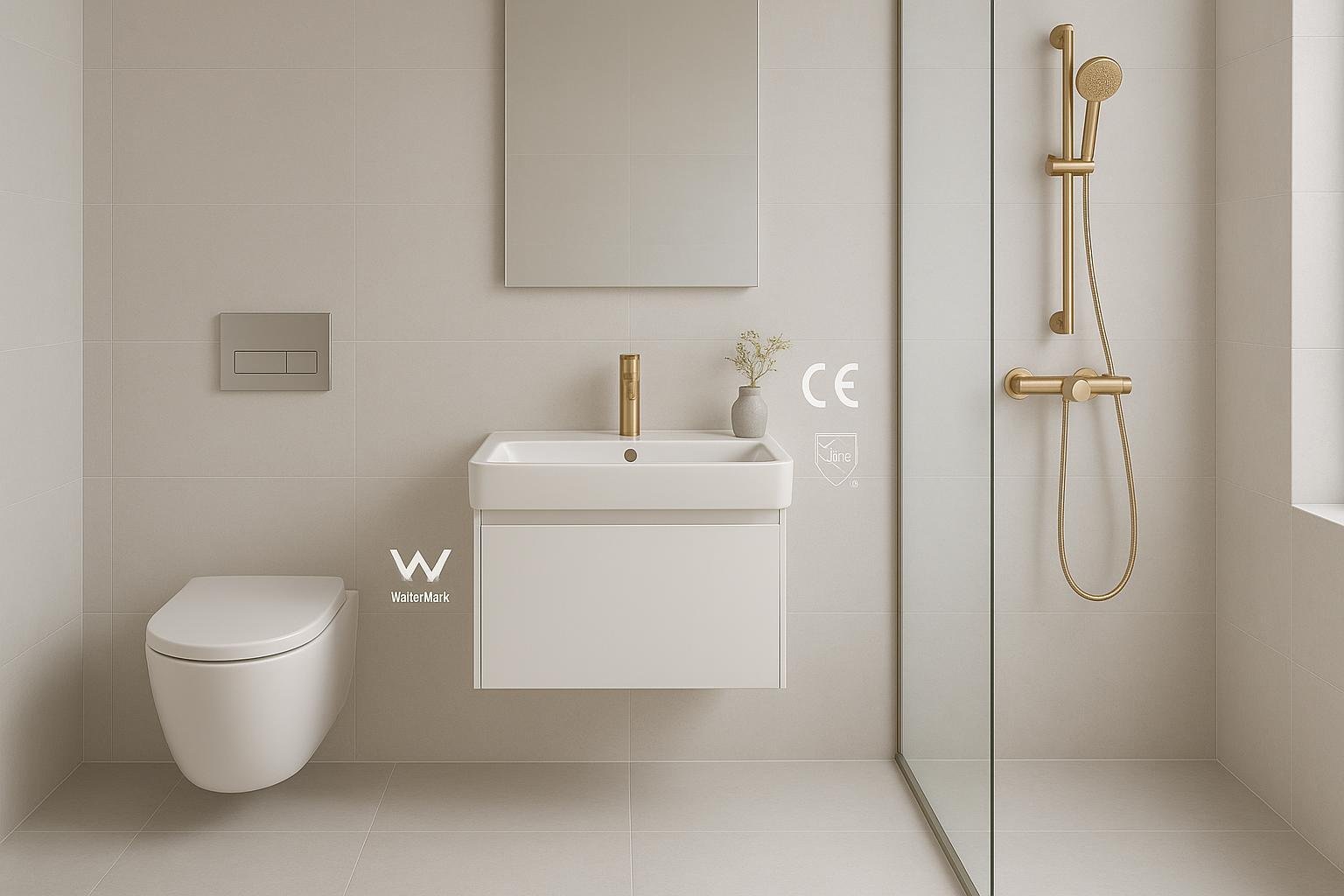
If you buy custom bathroom products from OEM manufacturers, certifications aren’t a box-ticking exercise—they’re your risk shield and your market passport. The Australian WaterMark scheme keeps unsafe or mislabeled plumbing products out of projects; CE under the EU Construction Products Regulation (CPR) enables lawful placement and transparent performance declarations across the EU. Together, they reduce warranty exposure, protect occupants, and shorten approvals.
This guide shows you exactly how to verify WaterMark licences and CE documentation, what “lead-free” means for Australia’s transition, how AVCP systems affect third‑party involvement, and how to run a fast buyer workflow from RFQ to pilot lot approval. You’ll also learn how to align your EU/AU data with U.S. cUPC, NSF/ANSI 61/372, and WaterSense to cut incremental costs.
Key takeaways
- WaterMark is mandatory for listed plumbing products in Australia; verify scope and licence status in the official database before purchase.
- CE under CPR requires a Declaration of Performance (DoP) per harmonised standard; check the DoP fields against Annex III and confirm any Notified Body via NANDO.
- Australia’s lead‑free rule for drinking water contact products becomes fully enforceable on 1 May 2026—plan materials and inventory accordingly.
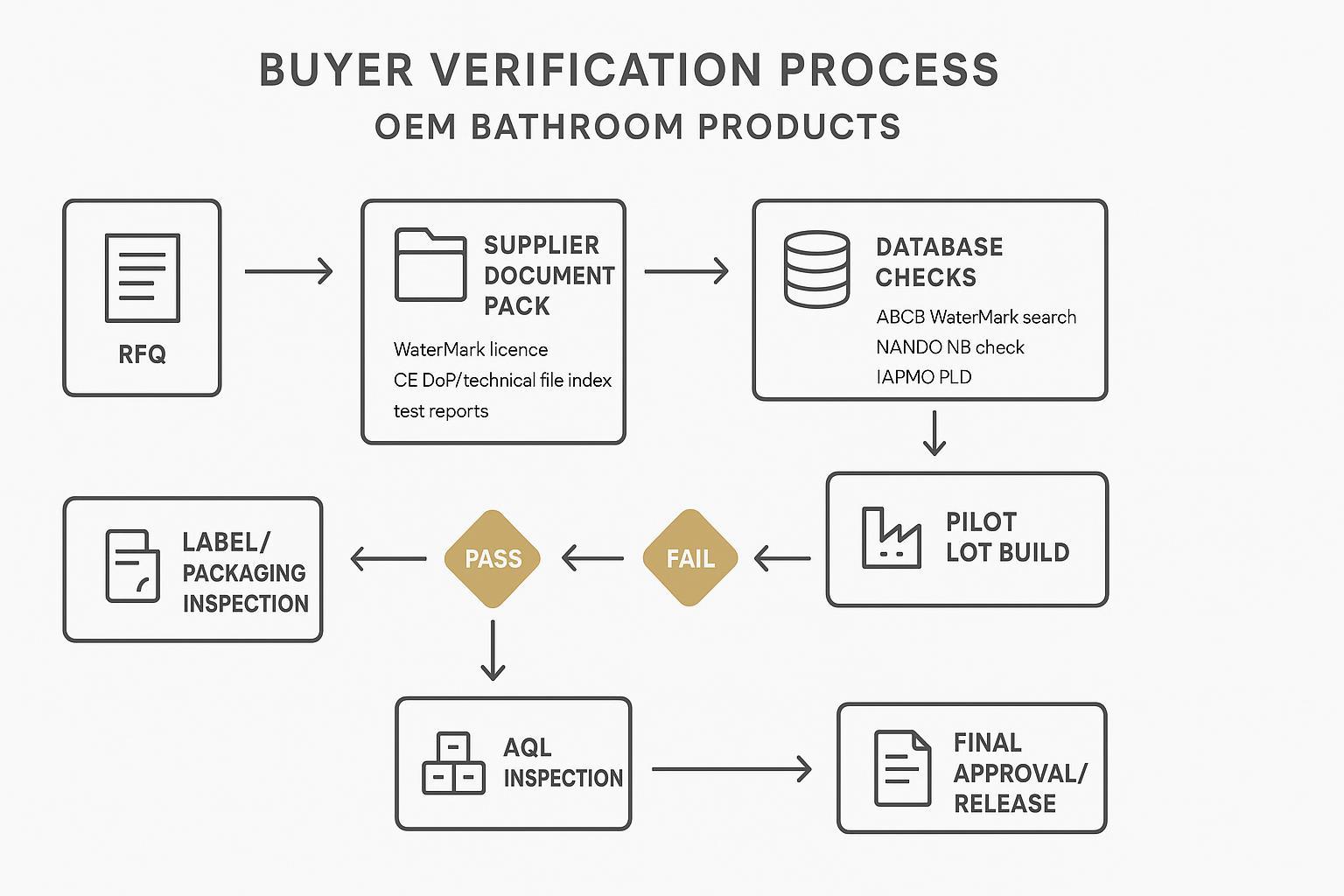
- A tight buyer workflow—documents → database checks → labels → pilot lot → AQL—avoids costly rework.
- You can reuse parts of WaterMark/CE data packs to accelerate U.S. cUPC and NSF/ANSI 61/372, and support WaterSense where applicable.
WaterMark essentials
Scope and mandatory coverage
WaterMark certification is mandatory in Australia for plumbing and drainage products listed in the WaterMark Schedule of Products under the NCC Plumbing Code of Australia. Always check whether your product type is included in the current Schedule and confirm it isn’t on the Excluded Products list. Start with the scheme homepage at the Australian Building Codes Board and review the official lists: see the WaterMark certification overview on the ABCB site and the current WaterMark Schedule of Products and Schedule of Excluded Products.
Authoritative sources to consult during scoping:
- WaterMark scheme portal: see the program overview at the ABCB’s WaterMark Certification pages at https://watermark.abcb.gov.au
- Scope lists: verify against the current WaterMark Schedule of Products PDF at https://www.abcb.gov.au/sites/default/files/resources/2025/WaterMark%20Schedule%20of%20Products%202025-3.pdf and the Schedule of Excluded Products PDF at https://www.abcb.gov.au/sites/default/files/resources/2025/WaterMark%20Schedule%20of%20Excluded%20Products%202025-1_0.pdf
Licensing, labeling, and database checks
A WaterMark‑certified product must be marked with the WaterMark trademark, the WaterMark licence number, and the applicable product specification; packaging and collateral should also carry the mark. Don’t take a PDF at face value—cross‑verify in the official database:
- Use the WaterMark Product Search to check licence number, brand, model name/ID, and authorization status. Search by licence, licensee name, or product type and confirm the listing matches your intended model family. Access the database at the WaterMark Product Search at https://watermark.abcb.gov.au/watermark-search
- Compare the database entry with the certificate and with physical labels/packaging. Any mismatch on model identifiers or scope is a red flag.
Lead-free transition timeline and impact
Australia is phasing in a lead‑free requirement for drinking water contact plumbing products. The transition period runs from 1 May 2023 to 30 April 2026. From 1 May 2026, only WaterMark products certified as Lead Free (weighted average lead content ≤0.25%) are authorised for use where required. Plan your designs, BOMs, and inventory turnover with those dates in mind. For details, consult the ABCB’s guidance on Lead‑Free plumbing products and the NCC update advice summarizing the new lead limits and dates: see Lead‑free plumbing products requirements on the WaterMark site at https://watermark.abcb.gov.au/plumbers/lead-free-plumbing-products and the NCC advice page at https://ncc.abcb.gov.au/news/2023/update-advice-new-lead-requirements
CE under CPR
Harmonized standards and AVCP systems
In the EU, CE marking for construction products follows the CPR. For sanitaryware and tapware, you’ll identify the applicable harmonised European standard (hEN), confirm the version cited in the Official Journal (OJEU), and determine the Assessment and Verification of Constancy of Performance (AVCP) system. AVCP defines whether a Notified Body (NB) must test or audit and the depth of Factory Production Control (FPC) evidence required.
Because OJEU listings can change, avoid memorized “AVCP mappings.” Instead, confirm the current basis in the law and official registries. The consolidated CPR text—especially Annex III for the DoP model and Articles 7 and 11–14 for obligations—is available via the EU’s legal portal: review the CPR legal text on EUR‑Lex at https://eur-lex.europa.eu/legal-content/EN/TXT/?uri=CELEX:32011R0305
Buyer pointers when assessing CE under CPR:
| What to confirm | Where to confirm | Why it matters |
|---|---|---|
| hEN applicability and OJEU‑cited version | OJEU/Commission harmonised standards listing | Only OJEU‑cited versions support valid DoPs |
| AVCP system for the product/standard | Same OJEU/Commission listing or standard’s Annex ZA | Determines NB involvement and FPC depth |
| NB designation and scope (if AVCP requires) | NANDO CPR directory | Ensures the NB is active and authorised for the task |
| DoP language and availability | Manufacturer’s site or document pack | Must be accessible in the destination Member State’s language |
Declaration of Performance and technical file
The Declaration of Performance is the heart of CE compliance under CPR. Annex III defines the mandatory fields. As a buyer, verify that the DoP is specific, complete, and consistent across documents and labels:
- Unique product type identification that maps to model IDs and drawings/BOM in the technical file
- Intended use(s) as defined in the relevant hEN
- Declared performance for essential characteristics with test method references; “NPD” only where the hEN permits
- AVCP system stated; NB name/number and certificate references where applicable
- Manufacturer’s name and address (and authorised representative, if used)
- Signature, date, and language suitable for the market of sale
You can compare these requirements directly against the legal model in the CPR text at the CPR text and Annex III on EUR‑Lex at https://eur-lex.europa.eu/legal-content/EN/TXT/?uri=CELEX:32011R0305
Using NANDO and verifying notified bodies
When AVCP requires a Notified Body—for example, to issue a certificate of constancy of performance or to perform FPC surveillance—confirm the NB’s designation and scope before you accept paperwork. In the European Commission’s NANDO directory, filter to CPR and search by NB name or number. Open the NB’s detail page, check that its status is active, and that its scope includes the relevant tasks for your product category. Start from the Commission’s filtered CPR view at Verify a Notified Body in NANDO at https://webgate.ec.europa.eu/single-market-compliance-space/notified-bodies/notified-body-list?filter=legislationId%3A154428%2CnotificationStatusId%3A1
Verification workflow for buyers
Document and scope matching steps
Begin at RFQ. Request a complete compliance pack: WaterMark licence PDFs and database listing URLs; CE DoPs per model family; a technical file index listing test reports, drawings, BOM, materials declarations, and FPC procedures; and, if relevant for your markets, U.S. cUPC listing URLs plus NSF/ANSI/CAN 61 and 372 certificates. Map each document to a single, stable model identifier. Ensure the intended use statements (WaterMark scope, hEN scope) match your application (e.g., potable water contact vs. non‑potable). Where Australia drinking water contact applies post‑2026, require evidence of Lead Free WaterMark.
Database and label cross-checks
Use official portals and compare line by line:
- For Australia, confirm the licence and model family in the WaterMark Product Search and match the licence number and model IDs to the certificate and the packaging label: consult the WaterMark Product Search at https://watermark.abcb.gov.au/watermark-search
- For CE, if an NB is referenced, validate the NB’s scope and active status in the Commission’s directory: see the NANDO CPR list at https://webgate.ec.europa.eu/single-market-compliance-space/notified-bodies/notified-body-list?filter=legislationId%3A154428%2CnotificationStatusId%3A1
- For U.S. plumbing listings, look up the product family in IAPMO’s Product Listing Directory and verify the exact listed model and standard: search the IAPMO cUPC listings at https://pld.iapmo.org
Common red flags to avoid
- The seller cannot provide a WaterMark licence number or a database listing, or the listing is “inactive.”
- The DoP omits essential characteristics, fails to state the AVCP system, or references a Notified Body not active or not designated for the claimed scope in NANDO.
- Model numbers vary across the certificate, database entry, label, and drawing package.
- “Lead‑free” claims for Australia after 1 May 2026 without a Lead Free WaterMark listing for drinking water contact components.
Factory capability and risk control
QMS, traceability, and witnessed testing
Insist on ISO 9001 certification and traceability from raw materials to finished goods—batch/serial IDs should connect materials certificates, process records, and final inspection results. Ask for evidence of witnessed type testing or surveillance by certification bodies and for calibration records covering endurance rigs, pressure benches, flow stands, and dimensional gauges. Factory Production Control should be documented, with control plans that reference the relevant WMTS/AS/NZS or EN clauses.
Disclosure: 9CREAT is our product. As a neutral example of an OEM/ODM approach, 9CREAT partners with buyers to align QMS checkpoints (incoming QC, in‑process SPC on pressure/endurance stations, 100% leak testing for wetted assemblies) with WaterMark and CE evidence needs. Buyers typically request a technical file index upfront and schedule witnessed tests tied to the pilot lot. Note that as of this writing, 9CREAT does not publish dedicated certification or QMS detail pages; see the brand homepage at 9CREAT for general background at https://9creat.com/
Any qualified OEM with ISO 9001, robust traceability, and accredited lab partnerships can follow the same model.
Endurance, pressure, and ceramic process controls
For tapware and valves, review cycle endurance (hot/cold), hydrostatic pressure, thermal shock, and flow accuracy checks against the applicable standards. For ceramic ware, verify kiln temperature profiles, water absorption targets, dimensional tolerances, and glaze integrity. Request sampling plans that prioritize critical features (seal integrity, structural strength, flush performance) and define re‑test triggers after tooling or materials changes.
Pilot lots, AQL inspections, and change control
Run a pilot lot before mass production. Agree on AQL levels (e.g., ANSI/ASQ Z1.4) and critical/major/minor defect definitions. Tie change control to certification impacts: any change in wetted materials, suppliers of critical components, tooling for sealing surfaces, or process parameters that could affect performance should trigger re‑approval and, if applicable, notification to certification bodies.
US market alignment
cUPC, NSF/ANSI 61/372, and WaterSense
To sell in North America, align early with cUPC, NSF/ANSI/CAN 61 and 372, and, for certain categories, EPA WaterSense. You can confirm cUPC listings in IAPMO’s public directory; NSF explains testing and certification pathways for 61 (health effects) and 372 (lead content), and the EPA posts up‑to‑date WaterSense product specifications.
- Search cUPC listings in IAPMO’s Product Listing Directory at the IAPMO cUPC listings directory at https://pld.iapmo.org
- Review NSF/ANSI/CAN 61 testing and certification program details at NSF’s official page at https://www.nsf.org/water-systems/nsf-ansi-can-61-testing-and-certification and the 372 technical requirements at NSF’s knowledge library at https://www.nsf.org/knowledge-library/nsf-ansi-can-372-technical-requirements
- Check product specification documents and program details at the EPA WaterSense hub at https://www.epa.gov/watersense/product-specifications
Sequencing multi-market certifications
Here’s the deal: sequencing saves time and money. If your product must meet Australia’s WaterMark (including Lead Free WaterMark for drinking water contact) and will enter the EU with CE under CPR, begin by fixing materials and performance designs to satisfy both families of standards. Capture type‑test data and materials declarations once, then compile consistent DoPs and WaterMark submissions. When you move to the U.S., reuse materials and performance evidence to speed cUPC and NSF review. For WaterSense categories, plan any extra performance tests early (e.g., flush performance, flow rates, and efficiency metrics) to avoid rework.
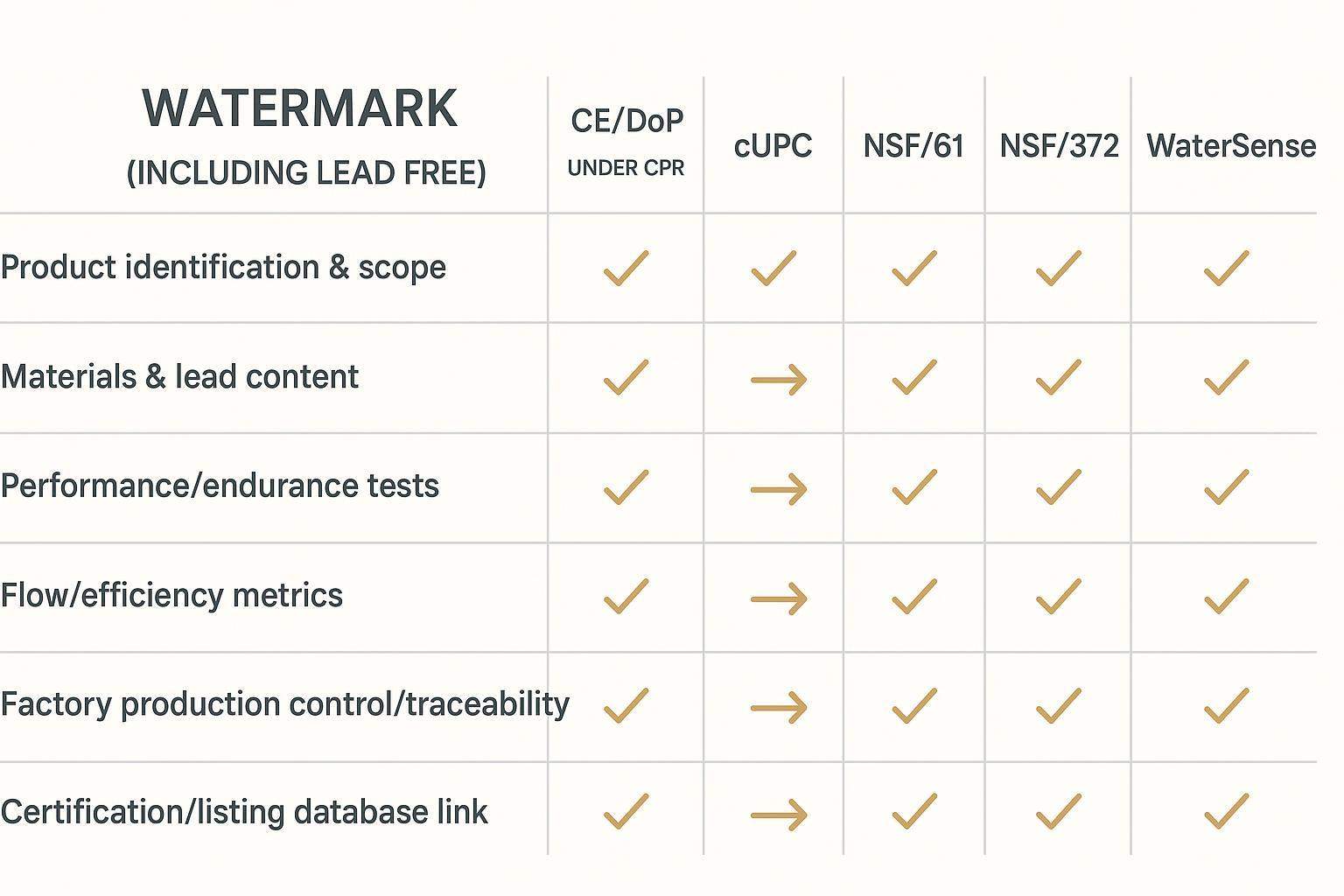
Data reuse to lower incremental costs
The biggest wins come from aligning product identification, materials/lead declarations, endurance/pressure data, flow/efficiency metrics, FPC documentation, and listing evidence. Use a crosswalk matrix to identify which fields transfer directly and which require retesting. The visual below maps typical reuse patterns across programs.
Action plan and selection checklist
Supplier shortlisting and audit plan
Shortlist OEMs that can provide live database listing URLs (WaterMark, cUPC where relevant) and sample DoPs on request. Schedule an audit that covers ISO 9001 scope, FPC procedures, calibration systems, traceability (batch/serial linkage), and witnessed testing capabilities. Request a pilot‑lot plan with defined AQL and re‑approval triggers.
Contract clauses and documentation control
Bake compliance into the contract: require access to DoPs and technical file indices; oblige notification and re‑approval for material/tooling/process changes that could impact compliance; reserve audit and surveillance rights; and define data retention periods for test reports, calibration logs, and batch records. Specify that database listings must remain active through the warranty period.
Implementation timeline and milestones
- RFQ and documentation pack due (WaterMark licence, DoP, technical file index, prior U.S. listings if any)
- Database verification complete (WaterMark, NANDO where applicable, cUPC)
- Pilot lot built; witnessed tests performed; AQL inspection passed
- Lead‑free conformance confirmed for AU drinking water contact items (if applicable)
- Mass production release with change‑control plan in force
Conclusion
A compliant OEM partner protects your projects, speeds approvals, and keeps you in good standing across markets. Focus on the essentials: WaterMark scope and licence status, a complete DoP under CPR with any NB designation verified in NANDO, and a disciplined factory program—traceability, witnessed tests, pilot lots, and AQL. Use smart sequencing and data reuse to accelerate cUPC, NSF/ANSI 61/372, and WaterSense without paying twice for the same evidence.
Next steps: lock your buyer workflow, audit the top two OEMs on your shortlist, and run a pilot lot before committing. If you need an OEM example to benchmark, review 9CREAT’s background page and ask for a technical file index and pilot‑lot plan aligned to your target markets.