Introduction
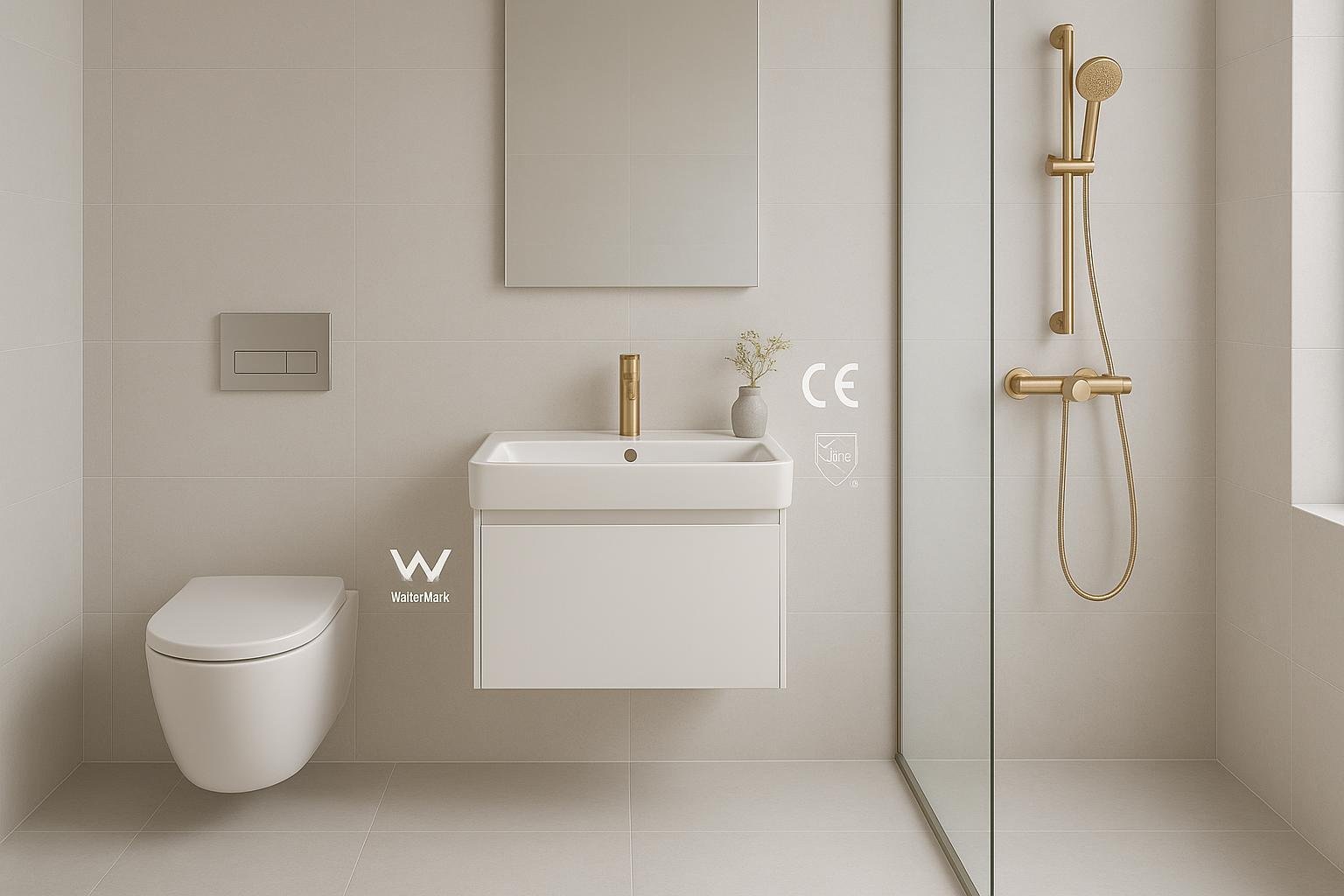
WaterMark and CE bathroom compliance must be reviewed for the exact product, intended use and destination. These frameworks are not interchangeable certificates or a guarantee that an order will pass every approval.
This guide focuses on document and listing checks. It distinguishes company background from model certification and notes that current legal transitions must be checked against official sources and the relevant jurisdiction.
Key takeaways
- WaterMark is mandatory for listed plumbing products in Australia; verify scope and licence status in the official database before purchase.
- Identify which EU legislation and transition route applies to the product. CE marking is not required under the same regulation for every bathroom item.
- For applicable copper-alloy drinking-water products, ABCB Notice of Direction 2021/4.3 distinguishes the 1 May 2026 certification/manufacturing transition from the 1 May 2028 installation transition; state and territory arrangements may vary.
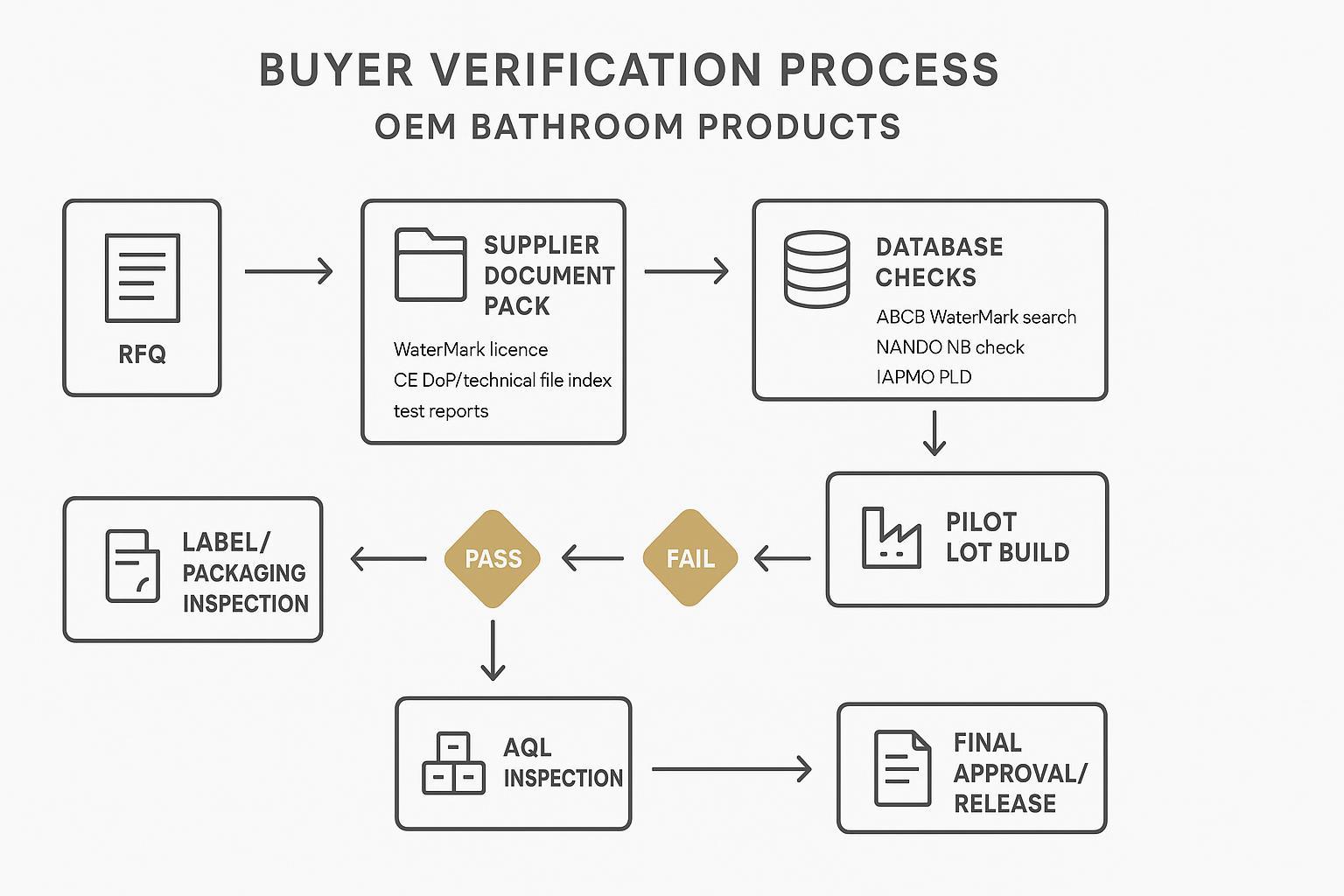
- A tight buyer workflow—documents → database checks → labels → pilot lot → AQL—avoids costly rework.
- Ask the relevant bodies whether test data can be reused; one scheme’s documents do not automatically establish another scheme’s compliance.
WaterMark essentials
Scope and mandatory coverage
WaterMark certification is mandatory in Australia for plumbing and drainage products listed in the WaterMark Schedule of Products under the NCC Plumbing Code of Australia. Always check whether your product type is included in the current Schedule and confirm it isn’t on the Excluded Products list. Start with the scheme homepage at the Australian Building Codes Board and review the official lists: see the WaterMark certification overview on the ABCB site and the current WaterMark Schedule of Products and Schedule of Excluded Products.
Authoritative sources to consult during scoping:
- WaterMark scheme portal: see the program overview at the ABCB’s WaterMark Certification pages at https://watermark.abcb.gov.au
- Current scope lists should be checked through the official scheme portal. The following fixed PDF is a historical reference, not a guarantee of the latest edition: https://www.abcb.gov.au/sites/default/files/resources/2025/WaterMark%20Schedule%20of%20Products%202025-3.pdf and the following excluded-products PDF also needs a currency check: https://www.abcb.gov.au/sites/default/files/resources/2025/WaterMark%20Schedule%20of%20Excluded%20Products%202025-1_0.pdf
Licensing, labeling, and database checks
A WaterMark‑certified product must be marked with the WaterMark trademark, the WaterMark licence number, and the applicable product specification; packaging and collateral should also carry the mark. Don’t take a PDF at face value—cross‑verify in the official database:
- Use the WaterMark Product Search to check licence number, brand, model name/ID, and authorization status. Search by licence, licensee name, or product type and confirm the listing matches your intended model family. Access the database at the WaterMark Product Search at https://watermark.abcb.gov.au/watermark-search
- Compare the database entry with the certificate and with physical labels/packaging. Any mismatch on model identifiers or scope is a red flag.
Lead-Free Certification and Installation Transitions
ABCB Notice of Direction 2021/4.3 sets different transitions for applicable copper-alloy products intended for contact with drinking water: certification and manufacture from 1 May 2026, and installation from 1 May 2028, subject to state or territory arrangements. The relevant lead-content limit is a weighted average of not more than 0.25%. Check the notice and the model’s current licence before making a purchasing or installation decision. The older general guidance linked here is background; consult the current notice through the scheme portal: https://watermark.abcb.gov.au/plumbers/lead-free-plumbing-products and review the current certification and installation transition notice: https://www.abcb.gov.au/sites/default/files/resources/2026/2021-4.3%20NoD%20-%20Certification%20transition%20for%20lead%20free%20plumbing%20products.pdf
CE under CPR
Identify the Applicable EU Regulation and Transition
The EU construction-products framework now includes Regulation (EU) 2024/3110 and transitional routes involving Regulation (EU) No 305/2011. The European Commission explains that product groups transition as the relevant specifications are adopted; one date does not move every product to the same route.
First identify the applicable product legislation, technical specification and assessment route. Review the 2024 regulation and identify the applicable transition route: https://eur-lex.europa.eu/eli/reg/2024/3110/oj/eng
Buyer pointers when assessing CE under CPR:
| What to confirm | Where to confirm | Why it matters |
|---|---|---|
| hEN applicability and OJEU‑cited version | OJEU/Commission harmonised standards listing | Check the applicable specification and legal route |
| AVCP system for the product/standard | Same OJEU/Commission listing or standard’s Annex ZA | Confirm the required assessment and control arrangements |
| NB designation and scope (if AVCP requires) | NANDO CPR directory | Ensures the NB is active and authorised for the task |
| DoP language and availability | Manufacturer’s site or document pack | Must be accessible in the destination Member State’s language |
Declaration and Technical Documentation
Request the declaration and supporting documentation required by the applicable product legislation and transition route. Do not assume every bathroom item uses the legacy CPR Declaration of Performance or the same annex fields. Useful document checks include:
- Unique product type identification that maps to model IDs and drawings/BOM in the technical file
- Intended use(s) as defined in the relevant hEN
- Declared characteristics and applicable test references for the product’s current route
- Applicable assessment route and third-party references where required
- Manufacturer’s name and address (and authorised representative, if used)
- Signature, date, and language suitable for the market of sale
The legacy legal model can be reviewed in the following 2011 text, but current requirements and transition arrangements must be identified separately: https://eur-lex.europa.eu/legal-content/EN/TXT/?uri=CELEX:32011R0305
Using NANDO and verifying notified bodies
When AVCP requires a Notified Body—for example, to issue a certificate of constancy of performance or to perform FPC surveillance—confirm the NB’s designation and scope before you accept paperwork. In the European Commission’s NANDO directory, filter to CPR and search by NB name or number. Open the NB’s detail page, check that its status is active, and that its scope includes the relevant tasks for your product category. Start from the Commission’s filtered CPR view at Verify a Notified Body in NANDO at https://webgate.ec.europa.eu/single-market-compliance-space/notified-bodies/notified-body-list?filter=legislationId%3A154428%2CnotificationStatusId%3A1
Verification workflow for buyers
Document and scope matching steps
At RFQ, identify the target market and exact model. Request the applicable licence/listing and declaration, supporting test references, drawings and material records. Keep model identifiers consistent and confirm whether the intended use is covered. For Australian drinking-water copper-alloy products, distinguish the current certification/manufacturing and installation transitions.
Database and label cross-checks
Use official portals and compare line by line:
- For Australia, confirm the licence and model family in the WaterMark Product Search and match the licence number and model IDs to the certificate and the packaging label: consult the WaterMark Product Search at https://watermark.abcb.gov.au/watermark-search
- For CE, if an NB is referenced, validate the NB’s scope and active status in the Commission’s directory: see the NANDO CPR list at https://webgate.ec.europa.eu/single-market-compliance-space/notified-bodies/notified-body-list?filter=legislationId%3A154428%2CnotificationStatusId%3A1
- For U.S. plumbing listings, look up the product family in IAPMO’s Product Listing Directory and verify the exact listed model and standard: search the IAPMO cUPC listings at https://pld.iapmo.org
Common red flags to avoid
- The seller cannot provide a WaterMark licence number or a database listing, or the listing is “inactive.”
- The DoP omits essential characteristics, fails to state the AVCP system, or references a Notified Body not active or not designated for the claimed scope in NANDO.
- Model numbers vary across the certificate, database entry, label, and drawing package.
- A lead-free claim unsupported by the model listing and applicable transition requirements for the jurisdiction.
Factory capability and risk control
QMS, traceability, and witnessed testing
Request quality-system, traceability and inspection evidence appropriate to the order. Where certification or witnessed testing is required, verify the actual scope, body and relevant records. ISO 9001 does not by itself certify every product.
9CREAT is the publisher’s own brand. This overview does not establish 100% leak testing, SPC stations, accredited laboratory partnerships or specific WaterMark/CE listings for its products. For general factory background, see https://9creat.com/
For a proposed order, confirm which model-specific records are available; do not infer certification from the company introduction.
Endurance, pressure, and ceramic process controls
For tapware and valves, review cycle endurance (hot/cold), hydrostatic pressure, thermal shock, and flow accuracy checks against the applicable standards. For ceramic ware, verify kiln temperature profiles, water absorption targets, dimensional tolerances, and glaze integrity. Request sampling plans that prioritize critical features (seal integrity, structural strength, flush performance) and define re‑test triggers after tooling or materials changes.
Pilot lots, AQL inspections, and change control
Run a pilot lot before mass production. Agree on AQL levels (e.g., ANSI/ASQ Z1.4) and critical/major/minor defect definitions. Tie change control to certification impacts: any change in wetted materials, suppliers of critical components, tooling for sealing surfaces, or process parameters that could affect performance should trigger re‑approval and, if applicable, notification to certification bodies.
US market alignment
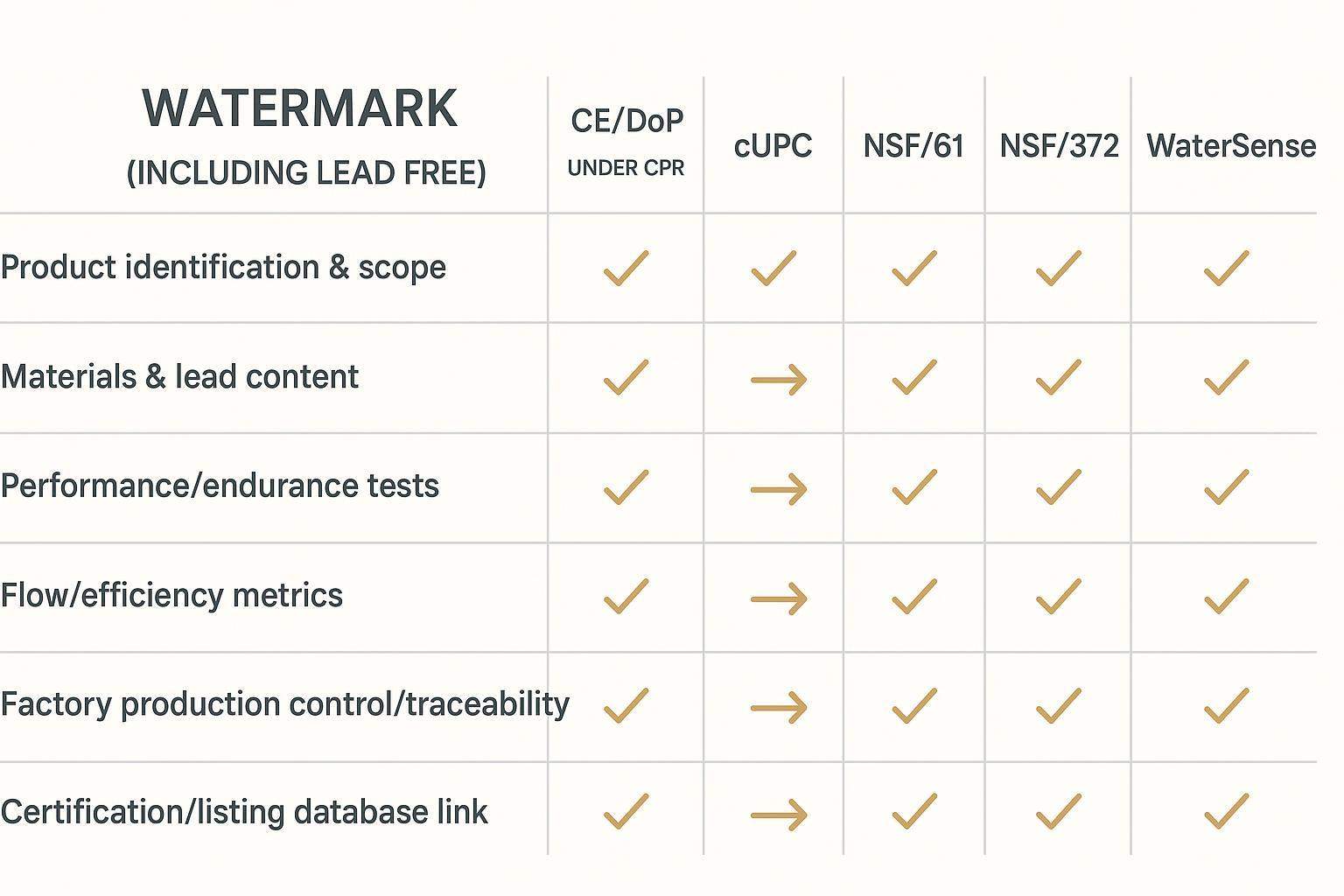
cUPC, NSF/ANSI 61/372, and WaterSense
For a North American order, determine the relevant plumbing, electrical, health-effects, lead-content and efficiency requirements for the selected product and jurisdiction. cUPC, NSF standards and WaterSense serve different purposes; none is a universal approval for every product.
- Search cUPC listings in IAPMO’s Product Listing Directory at the IAPMO cUPC listings directory at https://pld.iapmo.org
- Review NSF/ANSI/CAN 61 testing and certification program details at NSF’s official page at https://www.nsf.org/water-systems/nsf-ansi-can-61-testing-and-certification and the 372 technical requirements at NSF’s knowledge library at https://www.nsf.org/knowledge-library/nsf-ansi-can-372-technical-requirements
- Check product specification documents and program details at the EPA WaterSense hub at https://www.epa.gov/watersense/product-specifications
Sequencing multi-market certifications
For multiple destination markets, identify the requirements before finalizing the configuration. Ask the certification bodies whether existing evidence is acceptable and what additional work is required. Do not promise automatic recognition, reduced fees or shorter approvals.
Data reuse to lower incremental costs
Use a document cross-reference to match model identifiers, materials, intended use, testing and listing scope. Distinguish potentially reusable records from requirements that need new assessment. An illustration is not an approval from the relevant body.
Action plan and selection checklist
Supplier shortlisting and audit plan
Shortlist suppliers against the documents actually required for the order. Verify listings and applicable declarations, then agree on inspection, sampling and approval milestones. A generic factory profile is insufficient.
Contract clauses and documentation control
Agree on documentation access, relevant change notifications, responsibilities and record retention with the parties and appropriate advisers. The requirements should reflect the product, jurisdiction and applicable certification route rather than an unreviewed universal contract clause.
Implementation timeline and milestones
- RFQ and documentation pack due (WaterMark licence, DoP, technical file index, prior U.S. listings if any)
- Database verification complete (WaterMark, NANDO where applicable, cUPC)
- Pilot lot built; witnessed tests performed; AQL inspection passed
- Lead‑free conformance confirmed for AU drinking water contact items (if applicable)
- Mass production release with change‑control plan in force
Conclusion
Review WaterMark and CE bathroom compliance through product scope, current listings, applicable EU legislation and the relevant transition arrangements. Match the exact model across declarations, labels and records; company history does not replace those checks.
For 9CREAT enquiries, provide the destination, product references and required documents. Confirm availability and approval steps before ordering; this article does not promise certification, automatic multi-market acceptance or a guaranteed approval timeline.